
Reimagining Water Features for Functional Stormwater Management - Introducing VHA Integrated Water Feature Storm System (IWSS)
City Stormwater Infrastructure and Global Water Conservation: Two Growing Challenges
As cities push toward more climate-resilient and sustainable development, stormwater is no longer just an engineering concern—and neither is water consumption. At Vincent Helton & Associates (VHA), an architectural water feature design firm with over 40 years of experience and more than 1,000 projects across North America, we see it as both a design opportunity.
Globally, cities face increasing pressure to manage water responsibly. Climate change is intensifying rainfall patterns in some regions while prolonged droughts strain potable water supplies in others. Even in water-rich cities like Vancouver, the reality is clear: treating rainwater as waste while relying on potable water for decorative and experiential uses is no longer sustainable.
Effective January 1, 2026, the City of Vancouver implemented updated Rainwater Management Criteria, raising expectations for how developments manage rainfall on site. These requirements emphasize on-site detention, retention, and controlled release of stormwater to reduce peak flows and protect municipal infrastructure. As with energy codes and green building standards, Vancouver’s policies often signal broader adoption by other progressive cities in North America.
Today, the most common response remains the construction of large below-ground detention tanks. While technically effective, this approach increases construction costs, consumes valuable subsurface space, and treats stormwater purely as a compliance obligation—rather than a reusable resource. This reality raises a critical question: what if stormwater could be detained, treated, and reused above ground—integrated directly into architectural water features that provide both functional infrastructure and public value?
Introducing the VHA Integrated Water Feature Storm System (IWSS)
Expertise Meets Opportunity
VHA has over four decades of experience in the mechanical systems behind architectural water features, paired with a deep understanding of design, proportion, and placemaking. By merging technical rigor with strong design sensibility, we have delivered beautiful and reliable water features across North America. Today, we apply this expertise to help project teams—including civil engineers—meet increasingly stringent stormwater requirements without sacrificing space, aesthetics, or design intent. Developers and designers who adopt integrated strategies like this are better positioned to reduce costs, streamline approvals, and future-proof their projects.
Dual-Purpose Water Features
To address the dual challenges of stormwater management and responsible water use, VHA developed the Integrated Water Feature Storm System (IWSS), an innovative solution that transforms decorative water features into functional stormwater infrastructure. Building on decades of experience, IWSS introduces innovative automation, detention, and treatment strategies that meet contemporary regulatory expectations. By integrating stormwater management directly into the water feature’s design, the system eliminates the need for large underground tanks, preserves valuable urban space, and enhances the public realm with visually engaging, environmentally responsible water features.
How IWSS Works
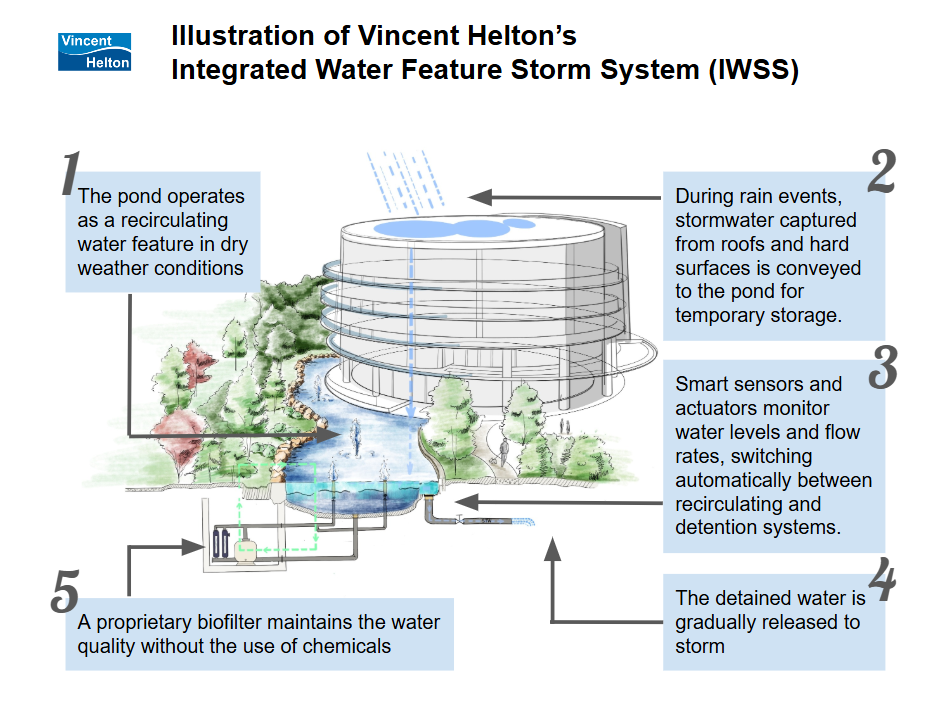
IWSS is designed to adapt seamlessly to changing weather conditions. In dry periods, the system functions as a traditional recirculating water feature, providing aesthetic appeal, acoustic comfort, and microclimate benefits while minimizing potable water use. During rainy periods, it automatically collects and detains runoff from building roofs and landscaped areas, storing water in basins engineered with detention capacity integrated into their geometry. The detained water is gradually released at a controlled rate, reducing peak flows and ensuring compliance with municipal rainwater management criteria.
Smart sensors and actuators monitor the different water levels and flow rates, automatically switching between decorative and detention modes. This automation minimizes maintenance, eliminates manual intervention, and ensures consistent performance year-round. Proprietary biofiltration and calibrated flow-control mechanisms allow detained water to be safely released into municipal storm systems rather than sanitary lines, delivering both environmental and regulatory benefits.
Design Rationale: Simplicity, Reliability, and Performance
IWSS emphasizes simplicity, reliability, and long-term performance. By limiting mechanical complexity and relying on automatic controls, maintenance remains straightforward, and the system adapts seamlessly to changing weather conditions. Detention capacity is primarily achieved through surface area rather than excessive depth, meaning not all decorative water feature typologies are suitable. Each design is evaluated holistically to ensure alignment between function and form.
Integrated bio-treatment ensures that detained water can be safely released into the municipal storm system, while calibrated orifice and flow-control structures regulate discharge to meet detention requirements. All design decisions are guided by two core principles: the system must meet or exceed municipal detention and controlled-release requirements, and the transition between decorative and detention modes must be automatic, resilient, and reliable, preserving the visual and experiential quality of the water feature throughout the year.
By integrating rainwater detention directly into decorative water features, IWSS turns stormwater infrastructure into something visible, functional, and intentional, contributing meaningfully to the landscape and public experience. In dry seasons, the system operates as a water feature with reflecting pools, fountains, cascades, and runnels, providing identity, acoustic comfort, and microclimate benefits. In wet seasons, it transitions seamlessly to stormwater detention, reducing peak flows and protecting municipal infrastructure.
Built and Operational: Real Project Applications
Broadway Tech Centre - Quadreal Property Group (2023)
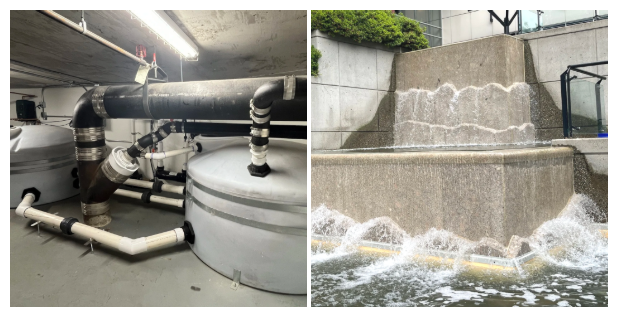
In 2023, VHA implemented an innovative rainwater harvesting system as part of a sustainable retrofit at Broadway Tech Centre in Vancouver. A detailed feasibility study of rooftop catchment potential led to a custom conveyance and pre-filtration system that captures clean rainwater and diverts it into the fountain’s holding tanks. This approach reduces municipal water use, minimizes stormwater runoff, and integrates seamlessly with a modern UV filtration upgrade, enhancing both aesthetics and long-term environmental performance.
Icon at SouthGate City - Ledingham McAllister (2024)
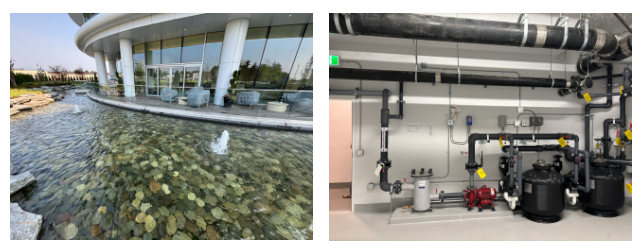
In 2024, Vincent Helton & Associates piloted this integrated approach at Southgate ICON in Burnaby, developed by Ledingham McAllister. A large architectural reflecting pond adjacent to the building lobby was designed to collect stormwater from the building roof and surrounding landscaped areas. The water feature functions as a prominent visual and social focal point while simultaneously providing stormwater detention without requiring additional land allocation. The system became fully operational in 2025 and has successfully delivered both functional stormwater performance and a high-quality landscape experience.
Menno Hall by Hyland (2025)
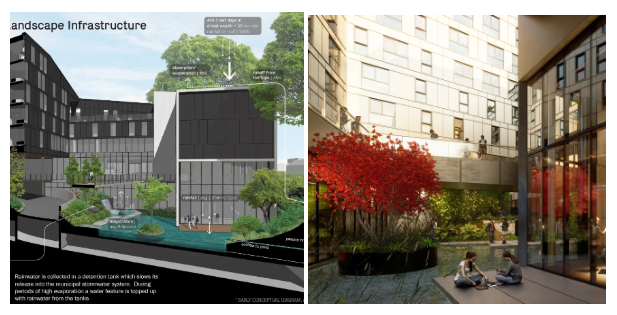
Building on this success, we advanced the concept further at Menno Hall at the University of British Columbia. This project integrates a green roof with stormwater detention directly within the pool volume and incorporates a proprietary bio treatment system designed to enhance water quality. Construction is scheduled for completion in the summer of 2026. Together, these projects demonstrate that stormwater infrastructure and placemaking can not only co-exist, but actively reinforce one another.
Rendering by Shape Architecture
Regulatory Certification and Ongoing Performance Tracking
From a regulatory standpoint, integrated water feature detention systems must be certified by a professional civil engineer as part of the project’s overall Rainwater Management Plan. VHA will work closely with the civil engineer to provide all the information and calculation during the certification process. In the City of Vancouver, this includes compliance with the Vancouver Building By-law, specifically Article 2.4.2.5 of Part 2, Division B, and alignment with the City’s Rainwater Management requirements.
The design should and will demonstrate that sufficient detention volume is provided above the permanent water elevation to temporarily store stormwater and release it at a controlled rate through an approved outlet structure. Detention volumes, release rates, and site drainage are calculated using the same methodologies applied to conventional stormwater systems, and each submission is subject to review and acceptance by City of Vancouver Plumbing Review staff at the time of permit application.
Beyond compliance, Vincent Helton & Associates also prioritizes long-term performance and accountability. We are in process of establishing an annual monitoring program to track water quality, water levels, and energy usage, ensuring systems continue to operate as intended. An in-depth performance report will be published in December 2026 to share outcomes, insights, and lessons learned.
Benefits For All
For cities and municipalities, these systems help reduce peak stormwater loads on aging infrastructure and promote on-site rainwater responsibility aligned with policy objectives. They support more resilient, climate-adaptive urban development without compromising the quality of public space.
For architects and landscape architects, this strategy transforms regulatory constraints into meaningful design opportunities. Water features become both infrastructure and expression, with the flexibility to adapt ponds, basins, and reflecting pools to project-specific design intent.
For developers, multi-functional water features provide a practical way to meet City of Vancouver stormwater requirements without sacrificing buildable area. By consolidating multiple functions into a single system, projects benefit from improved site efficiency and reduced approval risk through early alignment with emerging regulatory trends.
For property owners, integrating stormwater infrastructure into visible water features increases long-term asset value by transforming regulatory requirements into amenities. This approach reduces reliance on hidden, maintenance-intensive underground systems while enhancing marketability through sustainability-forward design.
For residents and end users, the result is engaging, beautiful water features rather than hidden stormwater facilities. These spaces offer visual comfort, sound masking, and microclimate benefits, allowing sustainability to be experienced as a visible and integrated part of daily life.
Engineering Water That Works Harder
At VHA, we believe water features should do more than look good. We collaborate closely with developers, architects, and landscape architects to create multi-functional water features that meet environmental goals, satisfy city regulations, and elevate the built environment. Let’s work together to reimagine water features as infrastructure—with elegance, innovation, and purpose.
Can you think of a project of yours that could benefit from incorporating this system? Let’s talk!